Why Over-Portioning Is an Execution Problem, Not Just a Food Cost Problem
Over-portioning impacts more than ingredient cost. It can reveal breakdowns in training, consistency, and brand execution. Learn how kitchen execution data helps operators identify portion variance, reduce waste, and improve performance across locations.
Introduction
Over-portioning is often treated as a simple food cost issue. In reality, it is usually a broader execution problem.
When portions drift from standard, the cause can be inconsistent training, unclear expectations, rushed service, station-level habits, or limited visibility into what is actually leaving the kitchen. The financial impact may show up in ingredient cost, but the operational issue starts much earlier.
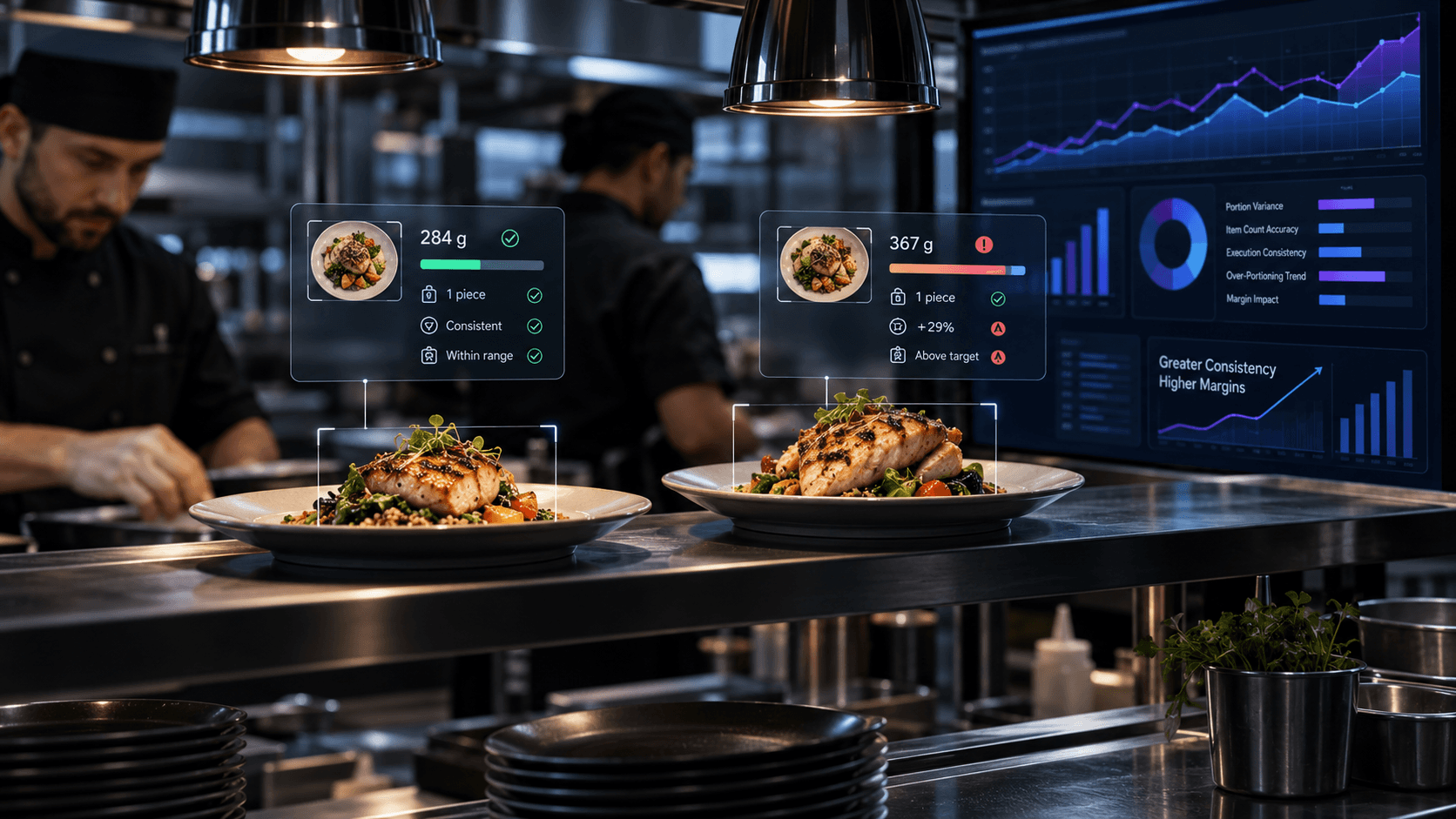
Kitchen execution data gives operators a way to see where portion variance is happening, how often it occurs, and whether it is isolated or systemic.
1. Over-Portioning Reveals Execution Drift
A portion standard can be clearly defined and still be inconsistently executed.
Across shifts, stations, and locations, small differences in preparation can compound into meaningful variance. Measuring plate-level execution helps operators identify where standards begin to drift and whether the issue is tied to a particular menu item, team, station, or location.
The value is not simply knowing that food cost increased. It is understanding where execution changed.
2. Small Variances Can Create Large Financial Impact
An extra ounce on one plate may seem insignificant. Repeated hundreds or thousands of times, it becomes a measurable cost.
For multi-location operators, small recurring portion differences can scale quickly across the enterprise. Execution data allows teams to identify which items are consistently over-portioned and prioritize the areas with the greatest potential financial impact.
This creates a more targeted approach to margin protection than relying on broad cost averages alone.
3. Portion Control Supports Brand Consistency
Portioning is not only about controlling cost. It is also part of the customer experience.
A guest receiving materially different portions across locations can experience the brand differently, even when the recipe is technically the same. Consistent portion execution helps reinforce expectations around value, presentation, and product quality.
For enterprise brands, that consistency becomes increasingly important as the number of locations grows.
4. Better Data Creates Better Coaching
When managers only see a food-cost variance at the end of the week or month, the opportunity to correct the underlying behavior may already be gone.
Execution data can give operators more specific information: which item, which location, and what type of variance is occurring.
That makes coaching more objective. Instead of telling a team to “watch portions,” managers can focus on specific recurring patterns and measure whether performance improves.
Emerging Trend: From Food Cost Reporting to Execution Intelligence
Foodservice technology is moving beyond reporting what was purchased, sold, or consumed.
The next layer of operational intelligence focuses on what actually happened during production and service.
Computer vision, connected devices, and AI are making it possible to measure execution closer to the point where variance occurs. Over time, this data can be connected with inventory, recipes, POS, labor, and financial systems to provide a more complete view of operational performance.
The shift is important: operators are moving from identifying margin problems after they happen to understanding the execution patterns that create them.
Final Thought
Over-portioning should not be viewed only as an ingredient-cost problem.
It is a signal.
It can indicate where standards are breaking down, where training may need reinforcement, and where operational consistency is being lost.
When operators can measure those patterns directly, portion control becomes more than a cost-saving exercise. It becomes part of a broader execution strategy that protects margin, strengthens consistency, and improves operational performance.